AI review that shows its working.
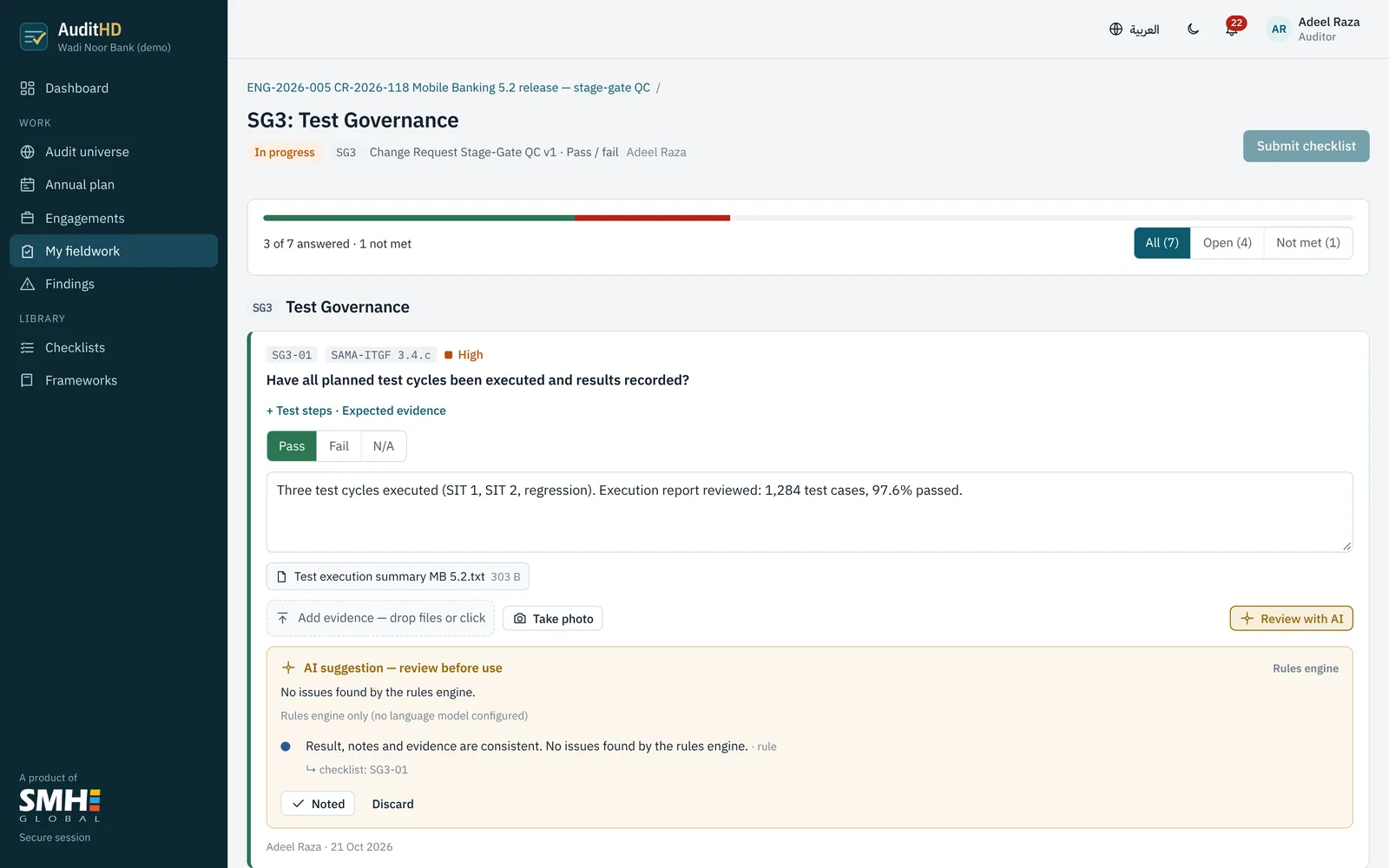
AuditHD's AI reviewer helps auditors write better workpapers and findings, faster. Every suggestion cites the clause and the evidence it relies on, is marked as AI, and needs a person to accept it.
Six jobs it does well.
- Review a checklist answer. Checks that the result, the note and the evidence agree, and that the evidence is final, dated and relevant.
- Draft a finding. Turns a failed item and its evidence into condition, criteria, cause, effect and recommendation.
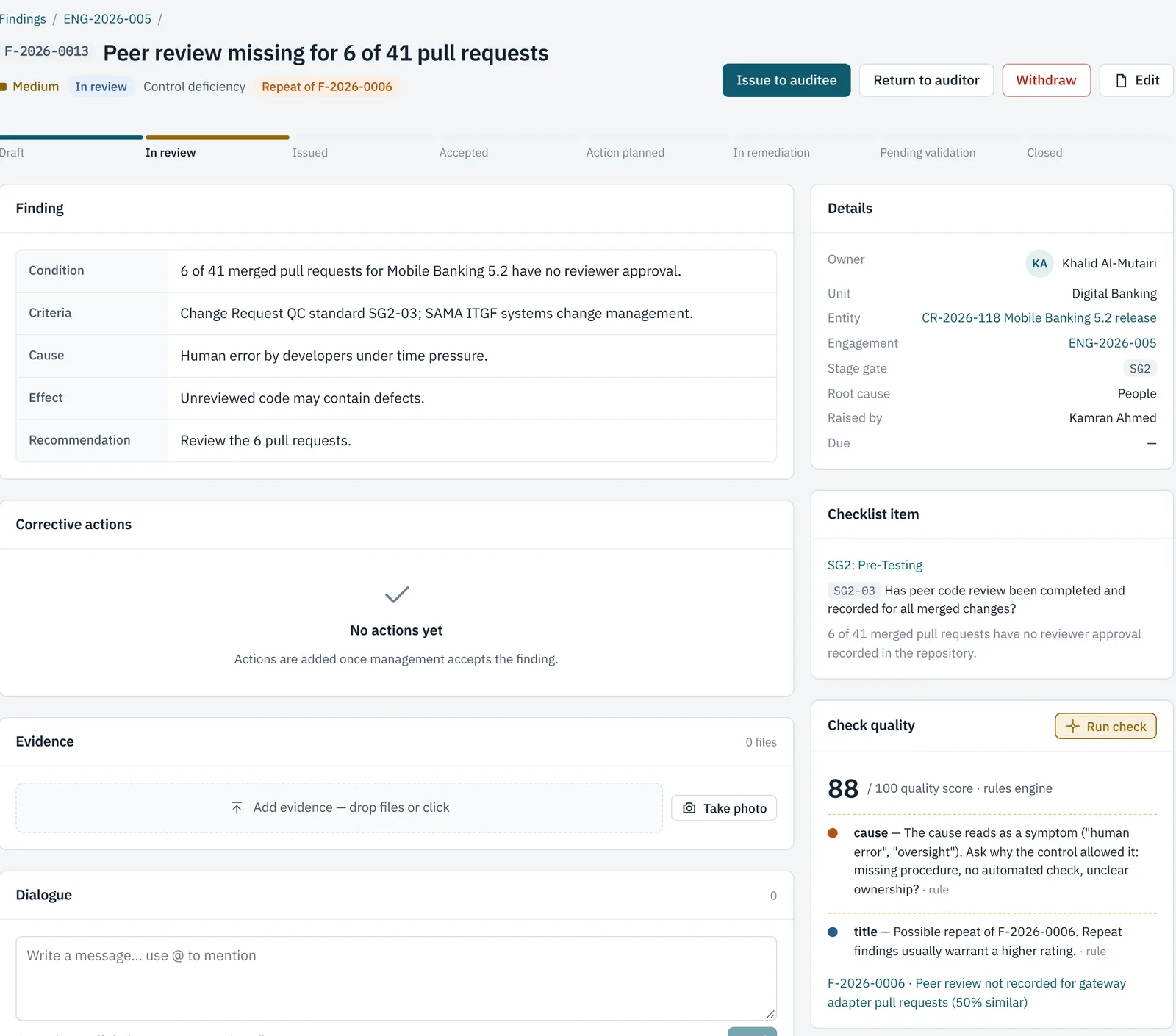
- Check a finding's quality. Flags causes that are really symptoms, missing criteria, vague recommendations and repeat findings.
- Draft a checklist. From the requirements you select or a short description of the review.
- Translate. Between English and Arabic, keeping clause references intact.
- Summarise an engagement. A draft executive summary for the audit committee.
Built for regulated work.
Audit evidence is confidential and findings carry weight. The AI is designed around that.
A person always decides
Suggestions are drafts. Nothing is issued, closed or changed until an auditor accepts it, and discarding is one click.
Citations are checked
Every reference and quote in a suggestion is checked against the real requirement and evidence text and marked verified or not, so an invented citation stands out.
Labelled as AI
AI content is visibly marked in the interface and in the record, in line with transparency rules such as the EU AI Act.
Logged either way
Each suggestion is recorded with the model, the time and the person's decision, so you can show how AI was used.
Personal data redacted
Before text goes to a cloud model, IBANs, card numbers, national IDs, phone numbers and email addresses are masked.
Rules engine fallback
With AI switched off, built-in rules still check workpapers and findings. Nothing depends on a model being available.
You decide where the model runs.
An administrator sets the hosting policy for the whole organisation. The policy is enforced on every request.
Off
Only the rules engine. Suitable for the strictest environments.
On-premises only
Open models such as Qwen or Llama on your own GPU server through Ollama or vLLM. Requests to any public address are refused.
In-country cloud
A provider hosted in your country with an OpenAI-compatible interface.
Any approved
Anthropic Claude, OpenAI or Azure OpenAI, with personal data redacted first.
API keys you enter are stored encrypted (AES-256-GCM). Check with your compliance function before enabling any provider outside your country; in Saudi Arabia, for example, SAMA expects approval for cloud services and for data processed abroad.
A quality check that knows audit.
The finding check reads like a senior reviewer. It knows that "human error" is rarely a root cause, that criteria should cite a requirement, and that a finding seen last year deserves a higher rating.
See it with your own checklists.
Open the live demo now, or book a walkthrough and we will load one of your frameworks or work programmes.