MARS™: show the auditor that management already knew.
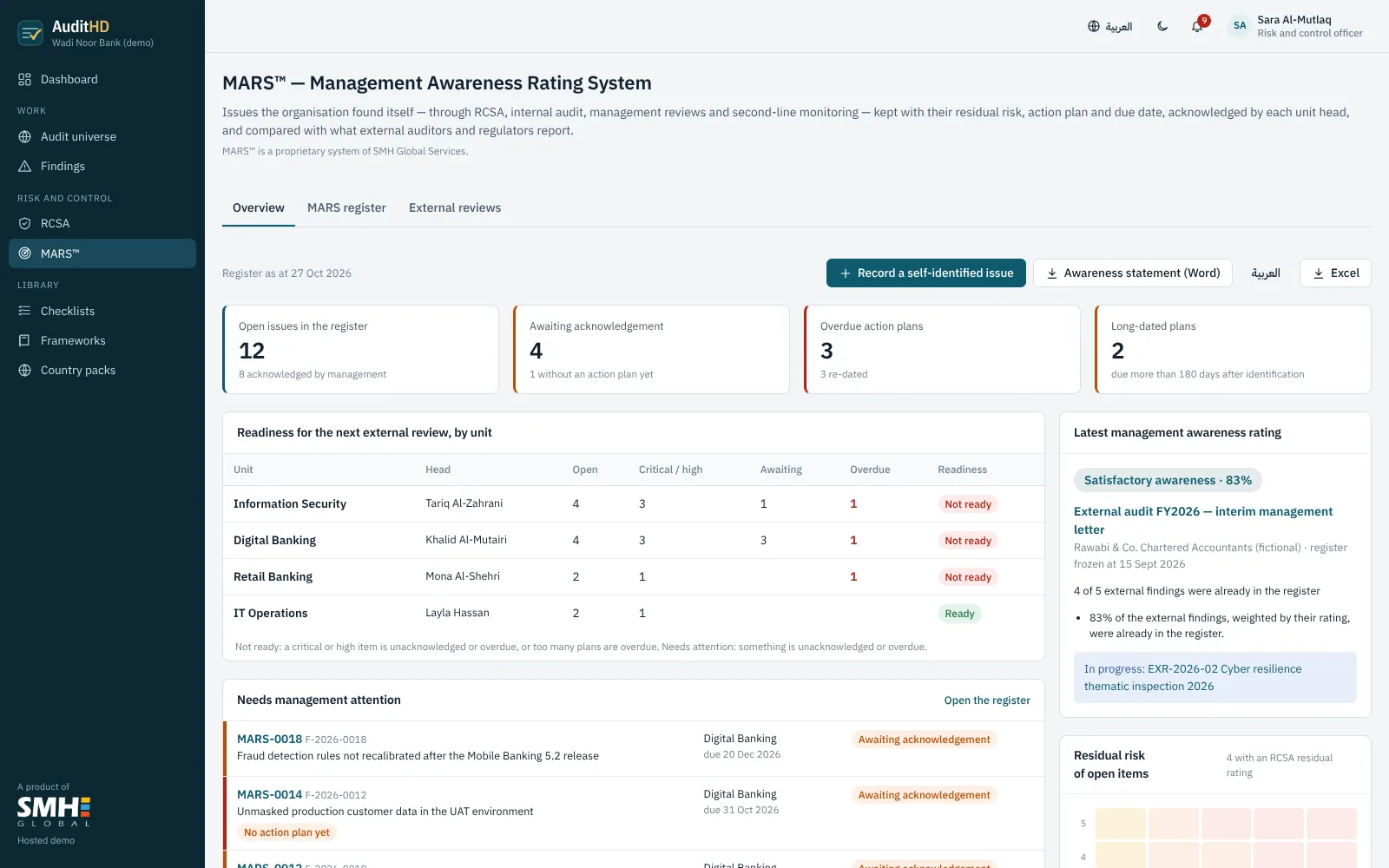
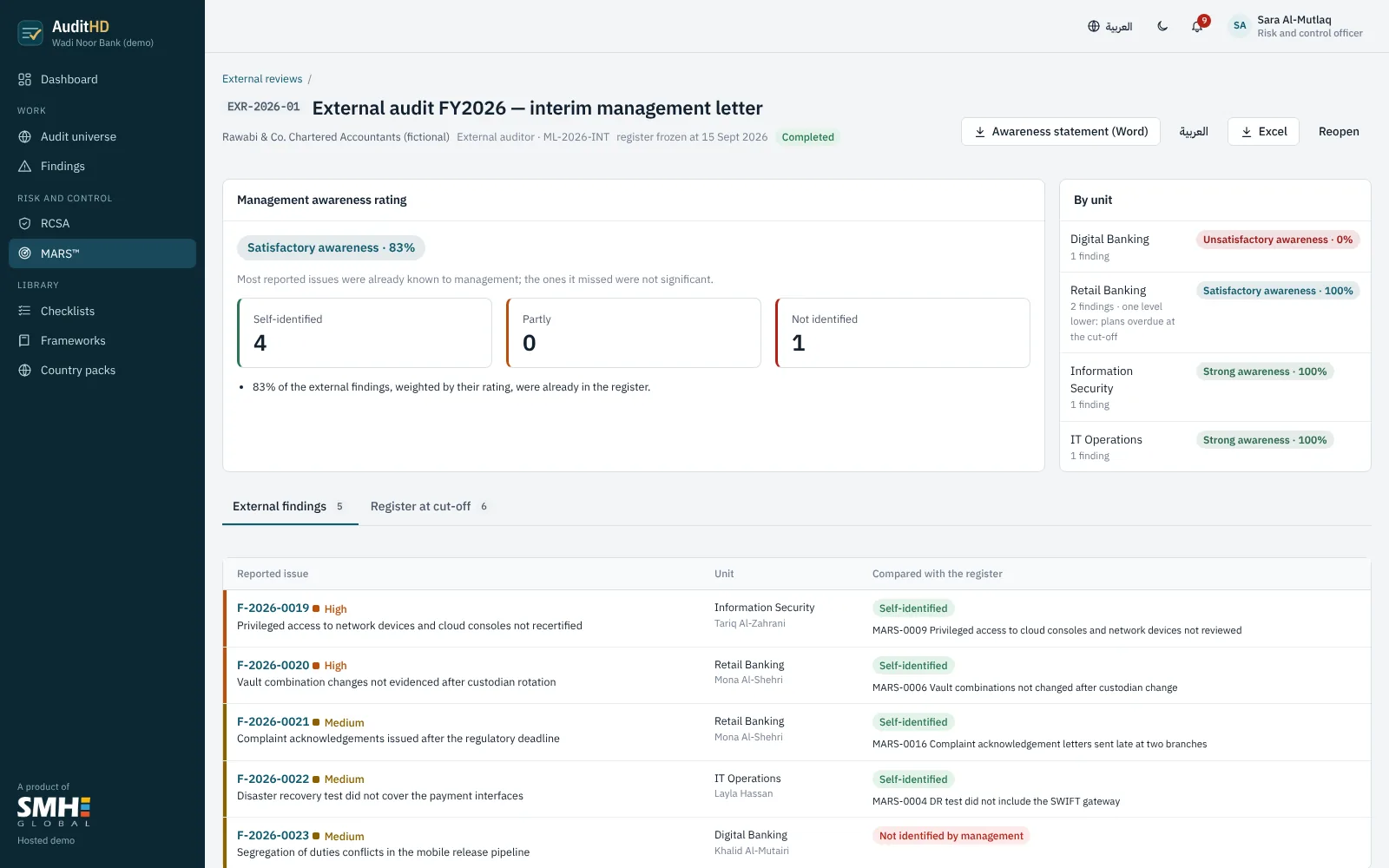
When an external auditor or a regulator arrives, the first question behind every finding is: did management know? MARS™ — the Management Awareness Rating System — keeps every issue your organisation found itself, with its residual risk, action plan and due date, signed by the head of each unit. You hand it over at the start of the review, and AuditHD rates management's awareness when the findings come in.
From self-identified issue to awareness rating.
MARS™ works with the RCSA and internal audit you already run in AuditHD. Nothing is retyped: the register fills itself from their findings.
- 1
Register what you found yourselves
Every open issue raised internally — a failed RCSA test, an internal audit finding, a weakness management found in its own review, a compliance monitoring exception — enters the MARS™ register with its residual risk, corrective action plan, owner and due date. Issues that are open, overdue, re-dated or long-dated are flagged.
- 2
Management acknowledges
The head of each unit confirms, in one click, that management knows the issue, the risk, the plan and the date. If the due date moves later, the item comes back for a new acknowledgement, so the register never shows a commitment management did not make.
- 3
Hand it over when the review starts
At the start of a statutory audit, a regulator's inspection, an external Shariah audit or a certification audit, the register is frozen at that date. The management awareness statement, in Word in English or Arabic, goes to the reviewer.
- 4
Compare and rate
Each finding the reviewer reports is compared with the frozen register: already known, partly known, or not known to management. MARS™ rates management's awareness overall and for each unit, from strong to unsatisfactory, and keeps the basis of the rating on record.
A rating the board and the regulator can follow.
The management awareness rating weighs what the reviewer found against what management had already disclosed, and how well management was keeping to its own plans. Significant issues that management did not know about limit the rating, whatever the overall share.
- Rated overall and for each unit, so the board sees where awareness is weak
- Every comparison, acknowledgement and change of date on the tamper-evident audit trail
- Register, comparison and rating in Excel; the statement in Word in English or Arabic
- Rating bands and registration rules set by your organisation
Built on RCSA
Residual risk from the quarterly RCSA sets the rating of each item, so the register shows what is at stake, not just how many issues are open.
Self-identified issues
Unit heads and the second line record issues they found themselves, with the action plan, in a single form. They go straight into the register.
Readiness before the auditor arrives
Each unit is ready, needs attention or is not ready, based on unacknowledged and overdue items, so you fix the gaps before the review starts.
External findings to closure
Findings from the external review go to their owners for a response and an action plan and are followed up with everything else.
Country packs
Works with the regulators of every country pack: SAMA, SBP, the Central Bank of the UAE, the CBB, QCB, CBK and CBO, the EU and the US.
Your data, your server
Runs wherever AuditHD runs: SaaS, in-country cloud or your own data centre.
MARS™ is a proprietary system of SMH Global Services, included with AuditHD's RCSA module.
See it with your own checklists.
Open the live demo now, or book a walkthrough and we will load one of your frameworks or work programmes.